

Agroforestry in India: 4 Systems and Regional Examples
Compare four agroforestry systems in India, from poplar and crops to coconut gardens. Use a practical checklist for water, layout, labour and markets.
Agroforestry in India includes trees grown with field crops, fruit trees with intercrops, managed trees and fodder, and gardens with several layers of crops. A suitable system depends on the farm's water supply, existing production, labour and buyers. The most useful comparison is between systems that could work on the same parcel.
This guide compares four documented Indian examples and turns them into a planning checklist. For the wider evidence on benefits and tradeoffs, read our agroforestry overview.
What are the major agroforestry systems in India?
The names describe the components. Agrisilviculture combines woody plants and agricultural crops. Silvopasture combines trees, forage and managed grazing. Agri-horticulture combines fruit trees and crops. A multi-storey system uses plants of different heights, such as palms, fruit plants and ground crops. These categories can overlap.
FAO's agroforestry guidance includes trees, shrubs, palms and bamboo deliberately integrated with crops or animals, either together or through a planned sequence. The arrangement matters. A species list alone does not explain how its components will share land, water or work.
Compare four documented regional examples
The combinations below come from government or agricultural research sources. The final column contains planning questions to resolve locally. Rainfall varies within each region, so a regional example is a starting point for discussion with a farmer and local extension team.
| System and region | Documented combination | Water and site context | Products and care to plan |
|---|---|---|---|
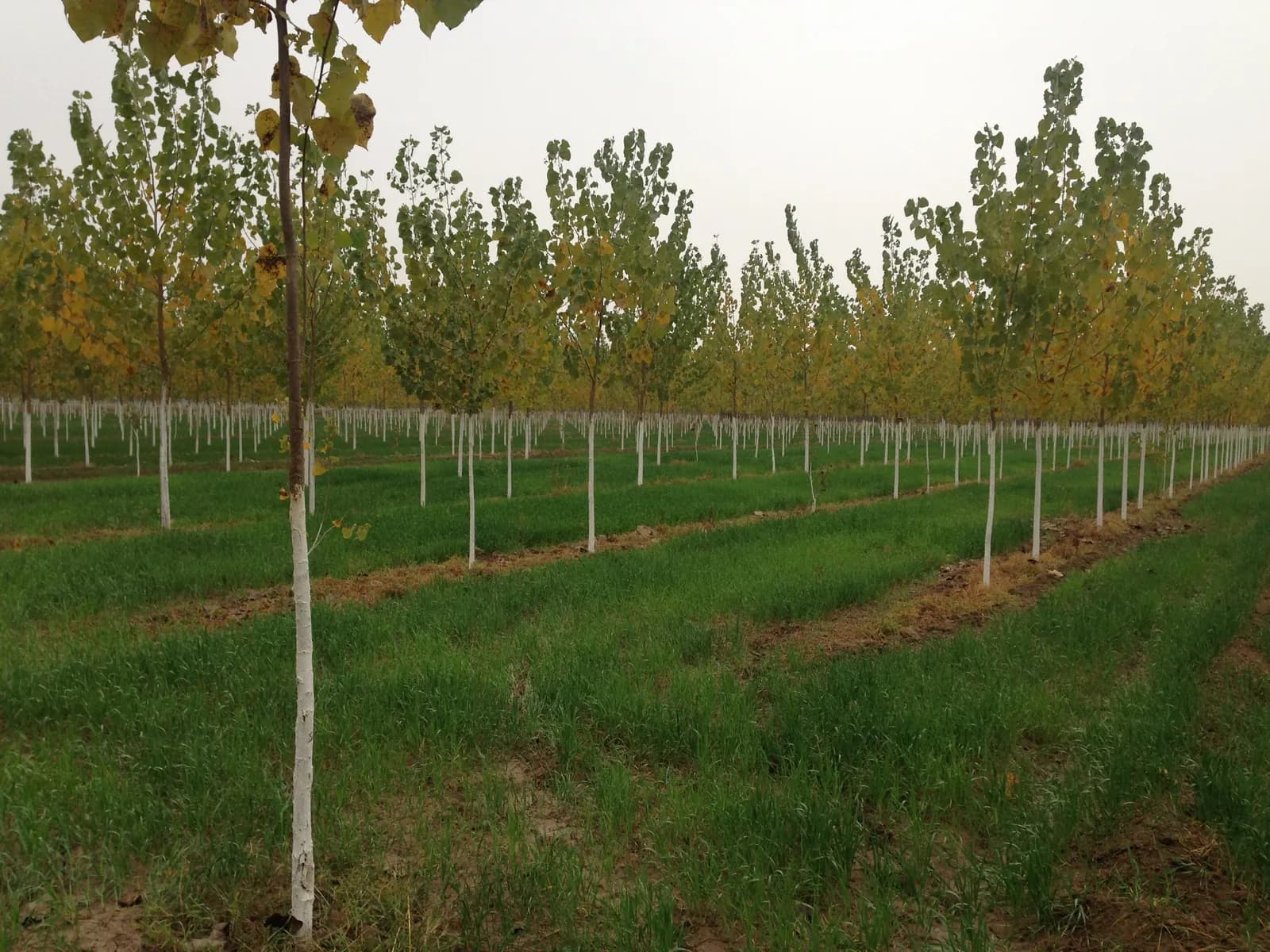
| Poplar with crops, Haryana and adjoining northern plains | Poplar with crops including wheat, mustard or sugarcane. | Check reliable water availability and soil suitability; the Haryana guidance identifies fertile soil and a high water table as favourable. | Crop harvests and wood. Plan pruning, machinery access and the eventual tree harvest. |
| Khejri with crops, Rajasthan | Prosopis cineraria with pearl millet, cluster bean or moth bean. | Western Rajasthan's dryland context requires a seasonal water budget and locally suitable establishment methods. | Annual crops alongside retained or established trees. Check crop operations and tree management together. |
| Aonla with crops, Bundelkhand | Aonla with combinations including black gram, green gram, groundnut, wheat or mustard. | Rainfall-dependent farming in a drought-prone region. Assess moisture conservation and establishment water. | Fruit and seasonal crops. Plan orchard care, harvest labour and fruit handling. |
| Coconut multi-storey cropping, coastal Odisha | Coconut with a middle layer such as banana, papaya or guava, and ground crops such as turmeric or cowpea. | Assess light beneath existing palms, drainage and water available through the dry season. | Several crop harvests. Budget for the extra crop care, inputs and access between layers. |
Poplar: design around the whole crop calendar
The Haryana Forest Department's account describes poplar becoming leafless in winter and lists a range of intercrops. That seasonal pattern is relevant to a winter crop; it does not mean shade and water competition disappear throughout the year. Ask how the proposed rows affect each crop operation as the trees grow.
Khejri: use the regional system, not a generic tree list
The NRSC portal's regional table, supplied by ICAR-CAFRI, lists khejri with pearl millet and several dryland crops for Rajasthan. Confirm the botanical identity, Prosopis cineraria, when discussing the example. A common name or genus alone is an inadequate planting specification. Record which existing trees will remain before deciding whether additional planting is needed.
Aonla: establishment water still needs an answer
A 2024 ICAR-CAFRI review of Bundelkhand agroforestry describes aonla-based combinations and the region's dependence on rainfall. A system described as suitable for rainfed conditions still needs an establishment plan. Identify where water would come from during a dry spell, who can supply it and which crop commitments must be protected.
Coconut gardens: account for the work between the palms
ICAR-CIWA documents an Odisha multi-storey model with middle and ground crop layers. Its combinations illustrate how an existing coconut holding can be arranged. Before copying one, check who will manage the additional harvests and whether irrigation, nutrients and access are adequate.
A checklist for choosing an agroforestry system
Tamil Nadu Agricultural University's agroforestry FAQ links tree choice to soil, climate, the time horizon, environmental goals and markets. Use those factors to compare actual options:
- Write the farm's priority. Is the household seeking fodder, fruit, wood, shelter or a combination? Identify the crop or grazing use that must continue.
- Draw the usable parcel. Include existing trees, paths, irrigation, boundaries and turning space. Mark areas that should remain open and any access shared with neighbours.
- Make a month-by-month water and work calendar. Put tree care beside sowing, weeding and harvesting. A labour shortage during establishment is part of the design problem.
- Check the sale or use of each product. Identify likely buyers, collection points, quality requirements and transport. Obtain current local information rather than copying old demonstration prices.
- Agree responsibility for the full tree cycle. Confirm landholder consent, who maintains and harvests the trees, and which local requirements must be checked before operations begin.
FAO recommends assessing costs and benefits and testing proposed systems on a small scale. A trial should answer a specific uncertainty, such as whether a crop remains workable beside the proposed rows. Decide in advance what result would make the team revise the layout.
An illustrative planning record for one farm
Imagine a farmer comparing boundary planting with rows inside a cropped parcel. The following record is hypothetical. It shows how to keep unresolved decisions visible before ordering seedlings.
| Question | Boundary option | Internal-row option | Evidence needed |
|---|---|---|---|
| Can machinery still operate? | Check gates and turning corners. | Check row spacing against each operation. | Walk the proposed layout with the operator. |
| Who provides dry-season care? | Responsibility not yet assigned. | Responsibility not yet assigned. | Name the person, water source and available time. |
| How will crop effects be assessed? | Record distance from the planted edge. | Record distance from rows and tree age. | Agree repeat observations and a suitable comparison area. |
| Is there a workable market? | Buyer requirements unknown. | Buyer requirements unknown. | Confirm product specifications and transport costs. |
Neither option wins from this blank record. Its purpose is to identify the few facts that would change the decision. Keep rejected options and the reasons for rejecting them so a later project team can understand the choice.
What should the project record after establishment?
Keep a parcel map, planting register, replacement history and records of crop operations. Give each planting cohort a date. Recording a replacement separately prevents it from being counted as an original tree that survived.
Match the record to the question: tree survival needs field observations; crop performance needs crop measurements; costs need accounts. A canopy map cannot supply all three. For projects spanning several farms, use the restoration monitoring guide to organise repeat visits and follow-up actions.
If your team needs to scope repeated tree-cover observations across a farm programme, discuss the monitoring requirement with Mynzo. Bring parcel boundaries, planting dates and the field records already available.
Common questions
Which agroforestry system is best in India?
There is no national winner. Compare locally suitable combinations against water, farm operations, care and the intended use of the products. A system documented in one region needs a fresh suitability assessment elsewhere.
Does agroforestry have to include livestock?
No. Trees with field crops are an agrisilvicultural system. Livestock introduces additional questions about grazing, forage and protection of young trees; include it only when those components are deliberately managed.
Can a small farm use agroforestry?
Boundary arrangements and mixed gardens can be considered alongside internal rows. The available area alone does not decide suitability. Check access, neighbouring uses, mature plant size and the work the household can sustain.
Sources checked on 31 October 2026. Regional systems are documented examples; the option-review record is an original illustrative exercise. Plant selection and management need local agricultural advice.
Plan the records for your chosen system
Connect planting, crop and field observations with the outcomes your project needs to track.
Use the agroforestry measurement checklist