

Ecosystem Restoration: Examples and Evidence of Recovery
Compare restoration in an Indian lagoon, a Florida river and a Scottish peatland. Learn how actions, early responses and ecological recovery differ.
Ecosystem restoration helps a degraded ecosystem recover. The appropriate work depends on what was damaged and what prevents recovery. It may involve restoring water movement, reducing a continuing pressure, supporting natural regeneration or reintroducing missing native organisms.
The Society for Ecological Restoration's 2026 international principles describe ecological restoration around assisting recovery, using an appropriate reference and clear goals. A completed intervention is the beginning of an assessment, not automatic evidence that the ecosystem has recovered.
How is restoration different from conservation?
Conservation includes keeping existing nature in good condition and preventing damage. Restoration addresses degradation that has already occurred. A landscape can need both: protection for a remaining habitat and recovery work on a damaged part of it.
Planting is an intervention, not a synonym for restoration. In a forest, establishing missing native trees may help. In a naturally open ecosystem, adding dense tree cover can conflict with the intended habitat. In a wetland, the first task may concern water rather than vegetation. Our afforestation and reforestation comparison explains the separate land-use terms.
The FAO, SER and IUCN-CEM Standards of Practice launched in 2024 cover a broad range of restorative work across ecosystems. State which outcome your project aims to achieve rather than relying on the word restoration to describe every environmental improvement.
Three ecological restoration examples
Chilika, India: reconnecting a lagoon with the sea
Chilika's problems included a restricted connection with the sea, changed salinity and effects on the lagoon's ecology and fisheries. The Chilika Development Authority's account describes opening a new mouth in September 2000 following hydrological studies, alongside other management and community work.
The authority reports subsequent changes in salinity, fisheries and other ecological conditions, supported by monitoring around the intervention. The lesson is the connection between a diagnosed physical process and a biological response. It is not a recommendation to open a new inlet in another wetland without understanding that system.
Kissimmee River, United States: restoring river and floodplain processes
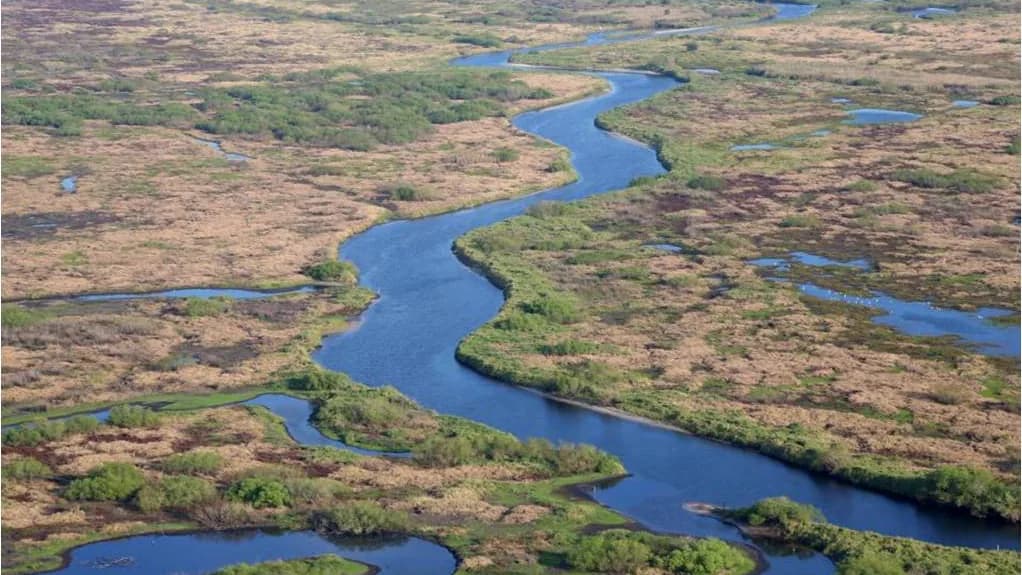
Channelisation altered the Kissimmee River and its floodplain. The South Florida Water Management District describes work with the US Army Corps of Engineers to backfill canal sections, reconnect river channels and restore floodplain conditions. Construction completion was celebrated in 2021.
The project's ecological evaluation programme compares observations with defined expectations. That distinction matters: completing earthworks is a construction result; checking hydrology, habitats and biological responses tests the ecological result. A ribbon-cutting date does not end the need for those observations.
Forsinard, Scotland: returning former forestry to blanket bog
NatureScot's Forsinard monitoring record describes removing former conifer plantations and blocking drains, followed in some areas by additional treatments. Water-table and vegetation measurements were used to compare restoration treatments with open-bog control plots.
This example makes a simple point: restoration can require removing trees where they have altered a peatland. It also shows why a treatment can need follow-up. The published monitoring data document a study design and observations; the presence of a dataset alone is not proof that every treated area has reached a fully recovered state.
| Example | Physical or management action | Ecological question to examine |
|---|---|---|
| Chilika lagoon | Improve the lagoon's connection with the sea within a wider management programme. | How did salinity and the lagoon's biological communities respond? |
| Kissimmee River | Reconnect river channels and floodplain processes. | Do hydrology and ecological observations meet the stated restoration expectations? |
| Forsinard blanket bog | Remove former plantation trees and address artificial drainage. | How do water levels and vegetation compare with suitable open-bog plots? |
An action, an early response and recovery are not interchangeable
The following example is hypothetical. A team works on a degraded woodland where the project has identified poor native regeneration. These records would support different statements:
| Stage | Possible record | Supported statement | Still unresolved |
|---|---|---|---|
| Action | The agreed pressure-reduction work was completed in marked treatment areas. | The planned work happened. | Whether it changed the conditions limiting regeneration. |
| Early response | Repeat plots record native seedlings and the conditions around them. | An observed response occurred during the survey period. | Whether seedlings survive, grow and represent the intended community. |
| Recovery assessment | Comparable records examine composition, structure and processes against the agreed reference. | The team can assess progress toward specified recovery goals. | Remaining differences, future pressures and evidence gaps. |
These stages need not advance at the same pace. A site can respond strongly in one respect while remaining impaired in another. Report each important attribute, rather than turning a good result for one measure into a claim about the entire ecosystem.
What makes a useful restoration goal?
A reference describes the ecological condition the work is trying to approach. It should fit the ecosystem and landscape, and draw on appropriate evidence. It is not simply the greenest neighbouring area or a photograph selected because it looks attractive.
For a project discussion, write a goal that allows the team to explain success and uncertainty. Compare these illustrative statements:
- Too vague: make the site greener.
- More useful: support recovery of the site's native woodland community by addressing the documented constraint on regeneration, then assess native recruitment and habitat condition against an agreed reference.
- Next decision: define the reference evidence, measurements, review period and what the team will do if the expected response is absent.
Discuss the goal with people who hold rights, use or manage the land. Local knowledge can explain drainage changes, past vegetation and continuing pressures that a recent image does not show. Those perspectives belong in the planning process, not just in a final account of benefits.
Should the team plant, remove a pressure or allow natural recovery?
The answer depends on what is missing and what is still present. Where native regeneration is occurring, preventing repeated damage may be more relevant than adding seedlings. Where important components or physical conditions are missing, further intervention may be necessary. An ecologist's diagnosis should come before the planting order. Compare these choices in the assisted natural regeneration guide.
Ask the team to compare its preferred approach with plausible alternatives, including a lower-intervention option. Record what evidence favours the choice and what could make it fail. If there is substantial uncertainty, a smaller trial with a suitable comparison may provide useful information before the method is applied across the site.
A visible change is not enough to select a method. More vegetation could include an invasive plant, and a wetter surface may not have the required seasonal pattern. Choose measurements that can distinguish the desired response from these alternatives.
Questions about ecosystem restoration
Does restoration mean returning to an exact historical date?
No. Historical evidence can help define an appropriate reference, but a project also needs to consider current conditions, future pressures and realistic recovery goals. State what the reference represents and why it is suitable.
How long does ecosystem restoration take?
There is no single timetable. Construction or planting can finish well before ecological recovery. Specify the response being assessed, its expected timescale and the evidence needed at each review.
Can an area be called restored as soon as work is complete?
It is more precise to say that treatment was completed, then report observed recovery separately. State the assessment criteria when using a stronger completion claim.
To put a recovery goal into repeatable visits and decisions, use the restoration monitoring plan and editable checklist. For a forest site, explore forest monitoring or discuss the observations your project needs. Specialist work should be agreed for the ecosystem and question involved.
Sources checked on 31 October 2026. The three named cases belong to their original project teams. The woodland example is illustrative, not a Mynzo result.
Build a record for the next site visit
Keep baseline observations, repeat measurements and follow-up actions together.
Use the restoration monitoring plan