
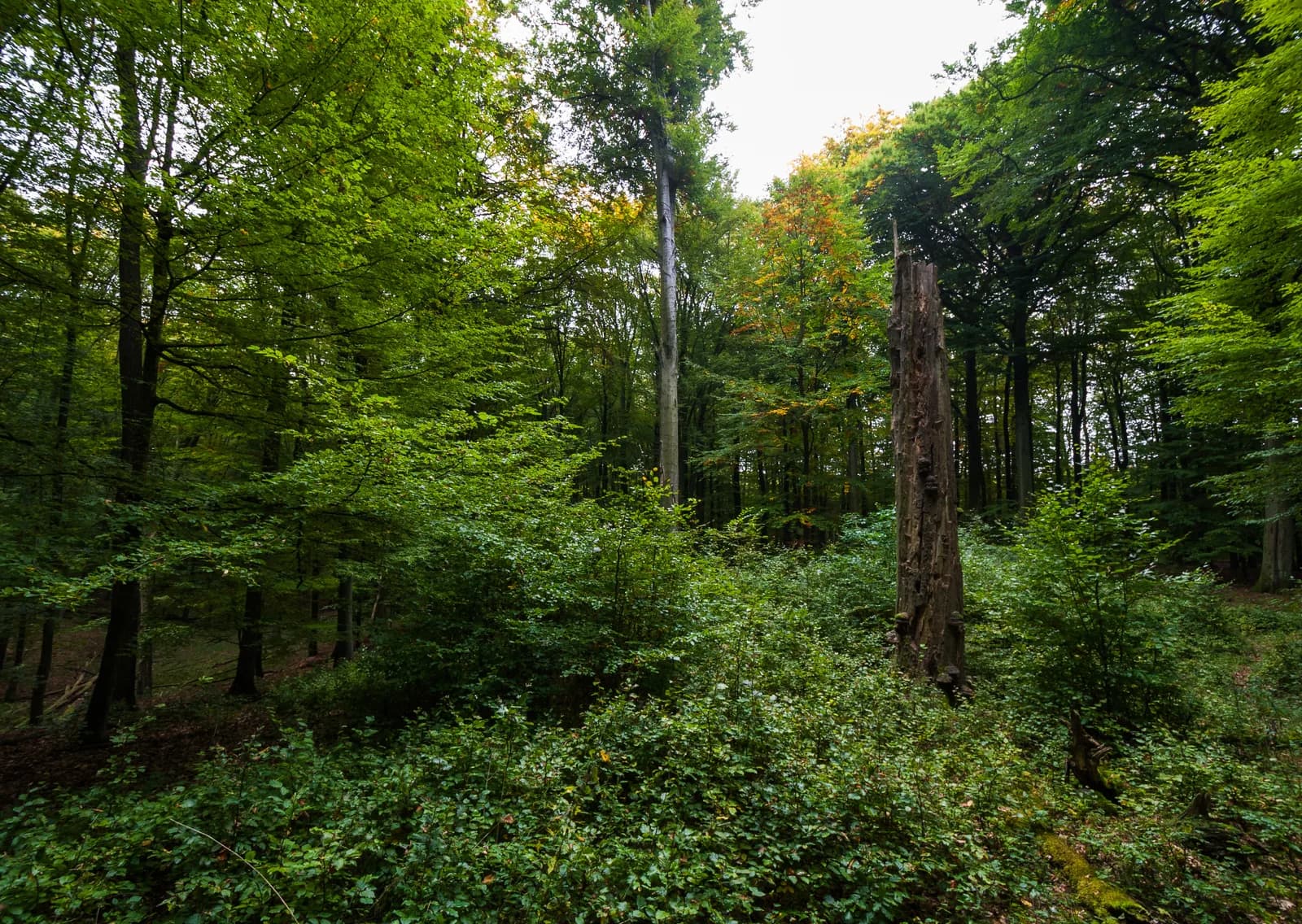

Assisted Natural Regeneration: A Guide for India
When can a forest recover without blanket planting? Compare assisted natural regeneration, passive recovery and planting, with evidence from India.
Assisted natural regeneration (ANR) helps a forest recover by addressing the barriers that prevent existing seedlings, shoots or incoming seeds from growing. It can involve protecting young trees, managing damaging disturbance and reducing competition around selected regenerants. Planting may still be needed where natural recovery cannot supply the intended species.
Check the ecosystem before encouraging more trees. A native grassland or savanna is not a failed forest. IUCN's restoration guidance says forest landscape restoration should not convert natural grasslands or other ecosystems. Establish the site's ecological history and present habitat with local knowledge and field assessment before choosing forest recovery as the objective.
ANR, passive regeneration and planting: what changes?
Natural regeneration describes how vegetation returns through seeds or vegetative growth. UN-REDD's glossary records both unassisted recovery and a broader definition that includes human assistance. To avoid ambiguity, describe the actual work alongside the method name.
| Approach | What the team does | When to investigate it | Main limitation |
|---|---|---|---|
| Passive recovery | Allows regeneration with little direct manipulation of vegetation. | Native recruitment is occurring and continuing pressures are low. | Missing species or unresolved damage may leave recovery stalled. |
| Assisted natural regeneration | Protects or releases existing regenerants and addresses identified obstacles. | Seedlings, resprouts or credible seed sources remain. | Assistance cannot replace an absent source of every desired species. |
| Planting, including enrichment | Adds selected plants across a site or in particular gaps. | Regeneration sources are insufficient, or important species are missing. | Planting still needs suitable conditions, maintenance and protection. |
FAO's forest restoration toolbox describes combining methods within a landscape. One parcel might need protection, another selective assistance, and another enrichment planting. These choices are separate from the land-use definitions of afforestation and reforestation.
What makes a site suitable for assisted natural regeneration?
FAO's ANR guidance brings ecological conditions and community support together. Before commissioning work, ask:
- What can regenerate? Identify native seedlings, resprouts and nearby seed sources.
- What is stopping them? Investigate soil condition, competition and repeated damage.
- Can the pressure be managed? Agree feasible responses to harmful grazing, harvesting or repeated fire.
- Who uses the land? Clarify rights, access, responsibilities and expected benefits with those affected.
- Who will maintain the work? Budget for follow-up and the labour it requires.
ANR field methods can include marking regenerants so crews avoid damaging them, selectively freeing them from competing vegetation, protecting them and checking the response. Specify the species and locations involved. Do not turn selective assistance into an instruction to clear every shrub or suppress fire across ecosystems with different ecological needs.
A useful commissioning question is: Which observed barrier will this treatment address, and what would show that it helped? A proposal that cannot answer that question needs more site investigation before a large work order.
Assisted natural regeneration in India: programme use and ecological limits
Rajasthan: ANR is one approach within a wider programme
The Rajasthan Forestry and Biodiversity Development Project includes assisted natural regeneration alongside other degraded-forest rehabilitation activities. Its official description also includes community micro-planning, baseline surveys and field documentation.
This establishes that ANR is part of an Indian public forestry programme. It does not establish a survival rate, a recovery timetable or a result for every project site. A team's own plan still needs to explain which intervention is suitable and how the people using the area will participate.
Western Ghats: a closed canopy can conceal missing species
A 2024 study by Osuri and colleagues compared 105 plots in rainforest fragments with 19 reference-forest plots in the Western Ghats. Some closed-canopy fragments still differed substantially from reference forests in their tree communities and carbon stocks. Seedling communities also suggested limited natural recovery towards the reference composition.
The researchers used simulations to examine enrichment options. Those simulations were not completed field restoration outcomes. The practical lesson is to inspect what is regenerating beneath the canopy: more tree cover alone cannot establish that missing rainforest species are returning. Read the habitat fragmentation guide for the wider landscape context.
Compare forest ANR with farmer-managed regeneration
UNCCD describes farmer-managed natural regeneration as a related practice on agricultural land, often working with trees that regrow from roots or seeds. Its examples include dryland farming in Africa. Farmers select and manage trees within an existing livelihood system; the objective need not be continuous forest cover.
That distinction matters when applying international experience in India. Compare tenure, crops, grazing, water and the desired vegetation before borrowing a treatment. The India agroforestry guide explores working farm systems in more detail.
A field decision example: one site, three different responses
This example is hypothetical. A team surveys three areas within a degraded former woodland. Local ecological assessment has already established that woodland recovery is appropriate. The observations below are invented teaching inputs, not Mynzo project results or universal thresholds.
| Area and observation | Working interpretation | Next step |
|---|---|---|
| A: Native seedlings occur across the area; many show fresh browsing. | Repeated damage may be limiting establishment. | Discuss grazing use with local users, then test an agreed protection measure. |
| B: Few seedlings are found; nearby seed sources are uncertain. | The survey cannot yet distinguish low seed arrival from other constraints. | Check identification, survey timing and potential seed sources before choosing planting. |
| C: Native recruits are growing without obvious damage. | Intensive intervention may be unnecessary. | Retain a lower-intervention option and repeat comparable observations. |
For Area A, mark the treatment boundary and retain comparable observations where feasible. At the review, ask whether browsing decreased and whether identified seedlings persisted. If neither changed, investigate why before repeating the treatment. Do not quietly expand the successful-looking part of the survey to stand for the whole site.
What should an ANR team record?
Use a short record that preserves the reason for the decision. Suggested fields are the area and survey date; identified native recruits and their distribution; suspected pressures; agreed treatment; responsible people; and the evidence needed at the next review.
Keep new recruits distinguishable from individuals recorded earlier. If enrichment planting is added, record those plants separately. A higher seedling count could reflect new germination while earlier seedlings died. Repeating the same method, area and suitable seasonal window helps the team interpret that difference.
For field records and handovers, use the restoration monitoring plan. For species composition and survey effort, use the biodiversity measurement guide. Both help turn a general recovery objective into a question the next visit can answer.
Common questions about ANR
Is assisted natural regeneration cheaper than planting?
It can reduce nursery and planting requirements, but costs depend on the site. FAO also notes that early work can be labour-intensive. Compare maintenance, access, protection and monitoring costs rather than treating unplanted hectares as free restoration.
Does ANR mean never planting a tree?
No. A project can assist existing vegetation and add missing native species through enrichment planting. Describe those components separately so the method and subsequent results remain clear.
How long should a team wait before changing the approach?
Set the review around the species, expected response and local seasons. A single visit cannot show a recovery trajectory. Agree in advance which observations would justify continuing, investigating or changing the treatment.
If you are scoping a forest project, bring the site boundary, regeneration observations and proposed treatments to a restoration monitoring discussion. Mynzo provides forest monitoring technology; field ecology and management responsibilities should be agreed for the project.
Sources checked on 31 October 2026. Published studies and programme descriptions belong to their original authors and organisations. The three-area example is a teaching exercise.
Turn a recovery decision into a monitoring plan
Record the starting conditions, repeat field observations and the findings that would change your approach.
Use the restoration monitoring plan