


How Does Deforestation Affect the Carbon Cycle?
Follow what happens to carbon in trees, wood products and soil after forest conversion, and why regrowth takes time to rebuild what was lost.
Deforestation changes the carbon cycle by releasing some carbon stored in vegetation and soil, while changing the land's future uptake of carbon dioxide. Burning can release carbon quickly. Decomposition and changes in soil can continue afterwards. The amount and timing depend on what was cleared, what happens to the wood and how the land is used next.
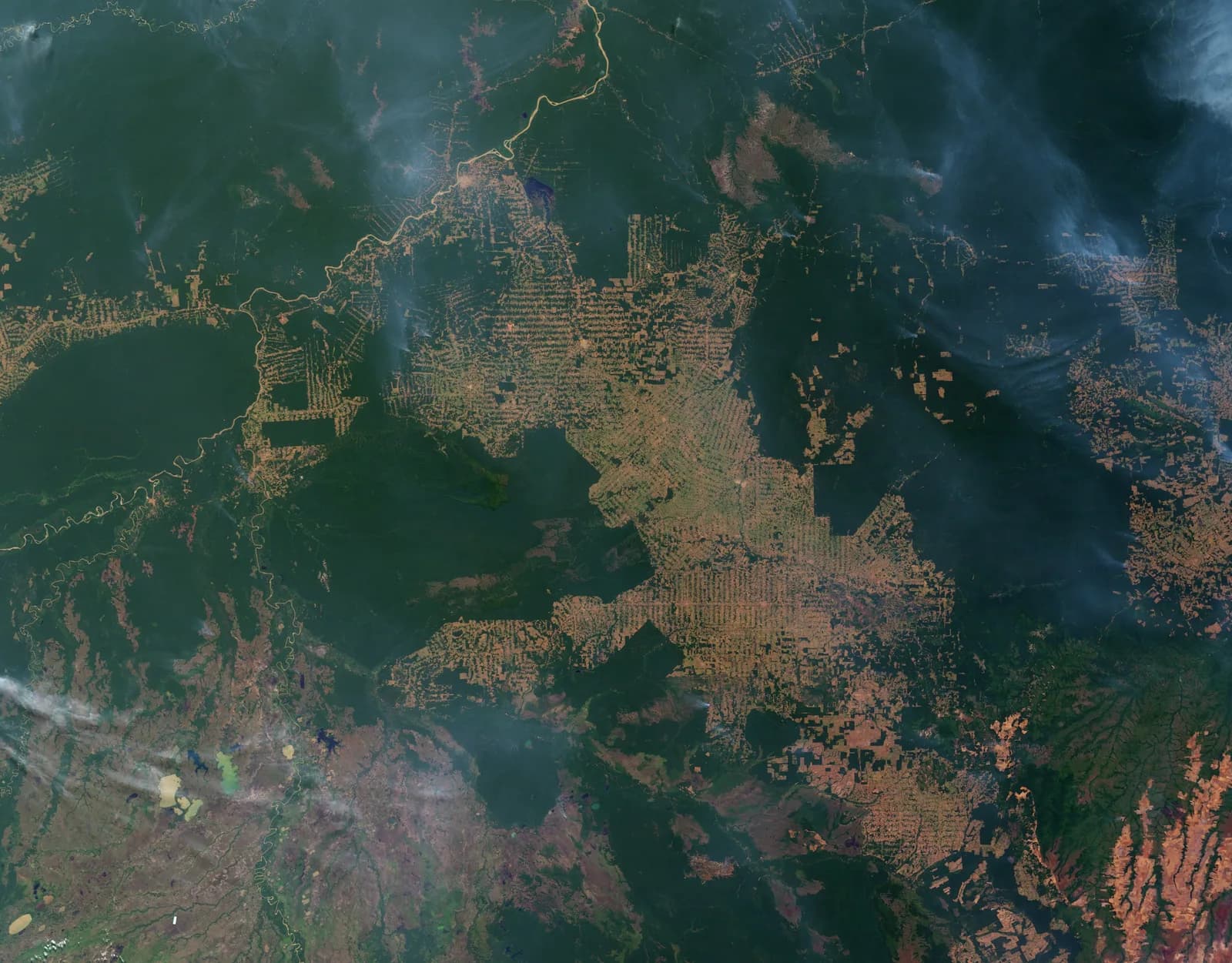
A photograph of cleared land shows a physical change. To understand its carbon consequences, follow the material: which carbon reaches the atmosphere, which remains in products or soil, and what vegetation replaces the forest? This guide explains those pathways before introducing a simple worked example.
How do forests contribute to the carbon cycle?
Plants take in carbon dioxide through photosynthesis and use its carbon to build living tissue. Some of that carbon passes into animals, dead material and soil. Plant and microbial respiration return carbon dioxide to the air. NOAA's carbon-cycle explanation describes these exchanges between the atmosphere, living organisms, soil and other reservoirs.
A carbon stock is an amount held at a particular time. A carbon flux is a transfer over a period. A forest can hold a large stock while both absorbing and releasing carbon each year. Whether it is a net sink or source depends on the balance over the area and period being assessed.
A NASA-supported study reported in 2021 mapped forest emissions and removals separately for 2001 to 2019. That distinction is useful even without using its global totals: losses in one place can coexist with uptake elsewhere. A global net sink does not mean every individual forest is gaining carbon.
Deforestation also needs a definition. The FAO's Forest Resources Assessment 2020 definitions distinguish conversion to another land use from temporary tree removal where forest regeneration is expected. Tree-cover loss is an observation; calling it deforestation requires information about land use and subsequent recovery. Temporary disturbance can still affect carbon.
What happens to carbon after a forest is cleared?
NASA's carbon-cycle guide explains two linked effects of clearance: carbon can be released from the existing vegetation, and removing that vegetation changes the uptake that follows. Replacement crops or grasses still photosynthesise. The comparison is with the forest and its likely future, not with land that has no biological activity.
| Material or process | Possible pathway | What changes the outcome? |
|---|---|---|
| Vegetation that burns | Some carbon enters the atmosphere during combustion. | How much material burns, combustion conditions and the carbon left behind. |
| Roots and woody remains | Carbon can be released through decomposition or retained in remaining material and soil. | Moisture, temperature, material properties and later management. |
| Harvested wood | Carbon leaves the site in products, residues or fuel. | The product's use, lifetime and eventual disposal or burning. |
| Soil organic matter | Stocks may change after altered inputs, disturbance or drainage. | Soil type, depth, water conditions and the replacement land use. |
| Future vegetation growth | New growth takes up carbon, with a different pattern from the former forest. | Land use, species, climate, management and continuing disturbance. |
The IPCC forest-land guidance separates biomass, dead organic matter and soil carbon because they respond differently. A canopy map cannot supply all three measurements. For the soil component, our soil-carbon guide explains why depth and bulk density matter alongside carbon concentration.
Wood leaving a forest is not necessarily an immediate emission
A beam in a building and wood burned as fuel have different carbon timelines. The IPCC chapter on harvested wood products accounts for carbon retained in products and subsequently released. Moving carbon beyond a mapped forest boundary is therefore different from proving that all of it entered the atmosphere that year.
Peat drainage adds a pathway below the trees
Where conversion drains organic soils, the soil itself can become a continuing emissions source. The IPCC's drained-organic-soils guidance treats soil emissions, waterborne carbon losses and fires separately. An assessment of a drained peat forest therefore needs water and soil information as well as a vegetation inventory. Its emissions should not be estimated simply by applying a tree-carbon value to the cleared area.
An example: where did the missing carbon go?
Imagine a deliberately simplified forest inventory containing 100 tonnes of carbon in living vegetation. After clearance, the record allocates that original carbon as follows. These are invented teaching numbers, not typical values per hectare or a Mynzo project result.
| Destination at the chosen date | Tonnes of carbon |
|---|---|
| Released to the atmosphere | 40 |
| Retained in harvested wood products | 25 |
| Dead roots and other dead material on site | 20 |
| Living vegetation still present | 15 |
| Total accounted for | 100 |
The living-vegetation stock fell by 85 tonnes, but the example records only 40 tonnes reaching the atmosphere by that date. The remaining 45 tonnes moved to products or dead material. Calling the entire 85-tonne decline an immediate atmospheric release would confuse a change in one pool with transfers across several pools.
The example excludes pre-existing soil carbon, new growth and any later decay. A real assessment must account for those processes over a defined period. If new growth adds an illustrative 2 tonnes of carbon in the following year, that is an annual gain. It is not the same quantity as the original 100-tonne stock, and it cannot be subtracted from several years of emissions without matching the periods.
Can reforestation reverse the carbon impact?
Regrowing forest can rebuild carbon stocks, but the pace is variable. Cook-Patton and colleagues' 2020 study compiled field measurements to map potential above-ground carbon accumulation during the first 30 years of natural forest regrowth. Rates differed substantially among locations. The study addresses a specified pool and period; it does not provide one repayment time for every cleared forest.
For a proposed site, ask what can regrow, what currently prevents it and whether recovery can persist. Land use, recurring disturbance and access to seed sources need attention. Our assisted natural regeneration guide considers when supporting existing recovery may be appropriate. A commitment to plant trees is an activity record; repeat measurements are needed to establish what carbon accumulated.
Carbon recovery also does not answer every ecological question. A site could gain woody biomass while retaining a different species composition or habitat structure. Read the ecosystem restoration guide for the wider evidence of recovery.
Five details a useful carbon claim should include
- Area and period: identify the land and the dates being compared.
- Pools: state whether the claim includes living vegetation, dead material, products and soil.
- Units: distinguish tonnes of carbon from tonnes of carbon dioxide, and totals from annual rates.
- Evidence: separate field measurements, satellite observations and modelled estimates.
- Comparison: explain the assumed land-use alternative and the uncertainty around it.
Those questions help a reader identify an incomplete claim before debating its headline number. For the measurement workflow, continue to forest carbon accounting.
Questions about deforestation and carbon
Does deforestation stop photosynthesis completely?
No. Remaining or replacement vegetation can still photosynthesise. Clearance changes the vegetation and its carbon exchanges; the size of that change depends on the land use that follows.
Is all carbon released as soon as a tree is cut?
No. Some remains in wood, roots, dead material or products. The timing of atmospheric release depends on burning, decomposition and what happens to harvested material.
Can a satellite image show the total carbon emitted?
An image can help identify vegetation change. Estimating emissions also requires information about carbon pools, material destinations and changes over time. A change map is one input to that calculation.
References checked on 31 October 2026. The numerical example is original and hypothetical; it is not an emissions factor or a carbon-credit calculation.
Follow the measurements behind a forest carbon estimate
See how field records, carbon pools and uncertainty shape the calculation.
Read the forest carbon accounting guide