

Causes of Biodiversity Loss: Five Drivers and India Examples
Explore five direct drivers of biodiversity loss through Indian research, with practical indicators, conservation responses and limits to each conclusion.
The five major direct drivers of biodiversity loss identified by the IPBES Global Assessment are changes in land and sea use, direct exploitation of organisms, climate change, pollution and invasive alien species. They can occur together. The dominant pressure on a particular forest, reef or species needs local evidence.
For India, a useful explanation connects these categories to specific observations. A shrinking habitat, a poisoned scavenger and a bleached coral need different responses. Counting more trees cannot answer all three problems.
What causes biodiversity loss in India?
1. Land and sea use change
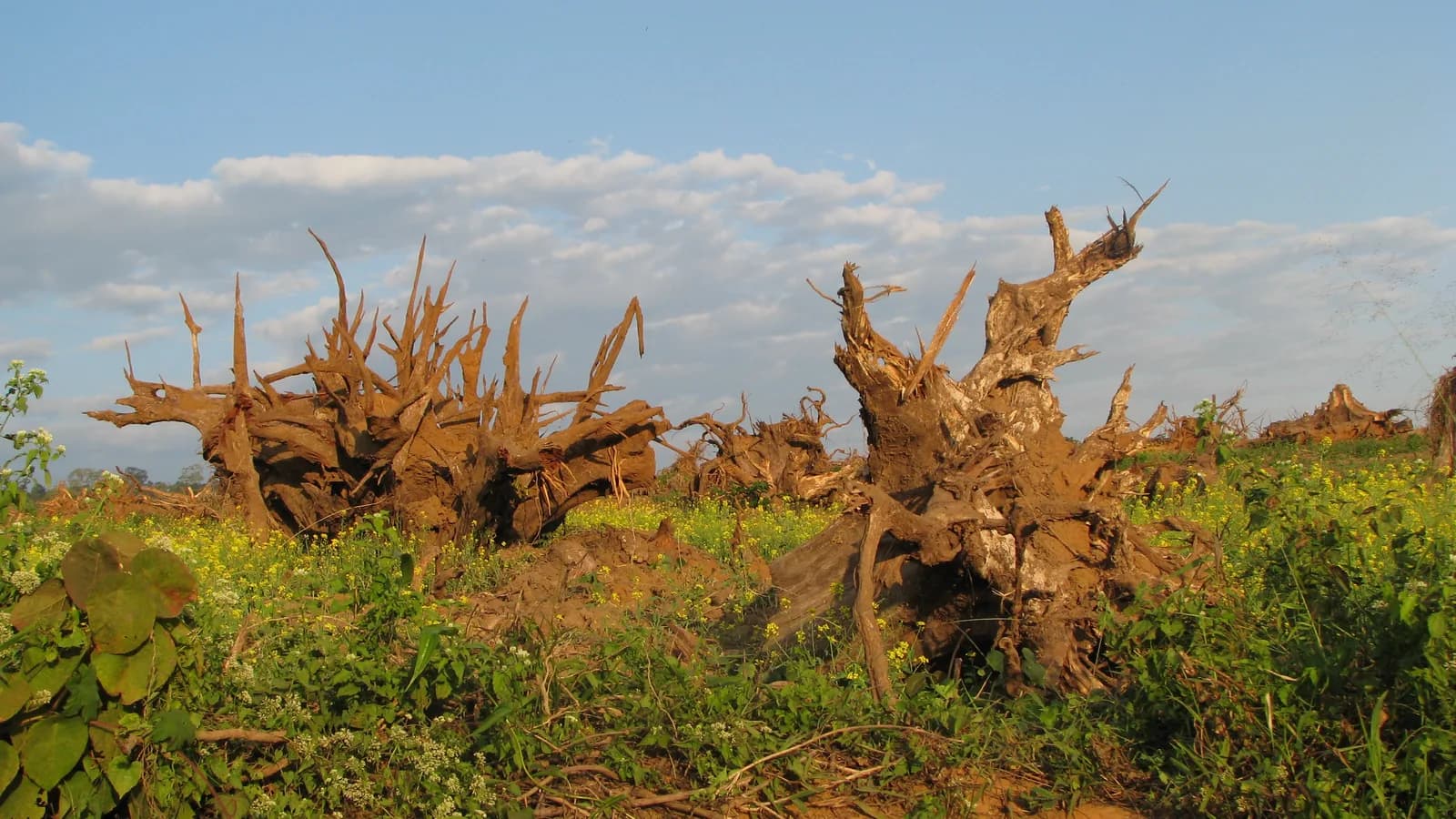
Conversion can remove habitat or alter the connections between the habitat that remains. A central Indian tiger genetics study published in 2013 found reduced gene flow between some reserve pairs that had lost forest connectivity. It illustrates why protected areas and the intervening landscape need to be considered together.
For a local investigation, compare habitat boundaries using consistent methods and dates. Then ask what the change means for the organisms present. A map of tree cover cannot by itself show whether a particular species has disappeared. Our fragmentation guide separates habitat area from movement evidence.
2. Direct exploitation of organisms
Harvesting becomes a biodiversity pressure when removal undermines the population or ecological system supporting it. An ICFRE research publication on red sanders identifies illegal felling for valuable heartwood as a major threat to natural populations. This is a specific example of removal pressure, rather than a claim that all use of forest products is unsustainable.
Relevant questions include which organisms are taken, at what life stage and rate, and whether recruitment replaces losses. Seizure records may reveal enforcement activity and illegal trade, but they are not a complete population survey. Pair pressure information with appropriately designed field evidence.
3. Climate change
In May 2024, ICAR-CMFRI reported widespread coral bleaching in Lakshadweep associated with marine heatwaves. Temperature stress and the coral response can be observed together, while subsequent surveys are needed to establish survival and recovery. Bleaching is not automatically the same as coral death.
This example also shows the limits of a local intervention. Reducing avoidable local damage may support a site's condition, but it cannot remove the global warming pressure driving marine heat extremes. A report should distinguish the pressure it measured from the action a local team can actually take. For other mechanisms and species studies, read how climate change affects animals.
4. Pollution
A 2004 study of dead or dying vultures in India and Nepal found diclofenac residues and associated pathology, supporting poisoning through contaminated carcasses as a major cause of the decline. The historical case shows that a damaging pollutant need not be visible in the landscape.
For an investigation, a pollutant measurement and a wildlife count answer different questions. Exposure records, suitable biological observations and other possible causes must be assessed together. A greener map would not establish that the food available to scavengers had become safe.
5. Invasive alien species
Being non-native does not by itself establish that a species is invasive. The concern is establishment and spread with harmful effects. A southern Indian dry-forest study compared fruit harvesting and invasive-plant pressures on two native amla tree species. It found that Lantana camara restricted regeneration in the studied populations. The research shows why a suspected cause, such as fruit collection, should be tested against other pressures.
Record the invader's extent and the native community's response. Area cleared is work completed; it does not establish that native plants have recovered or that reinvasion has stopped. Where people use an introduced plant, management also needs to account for those uses and suitable alternatives.
Direct drivers are not the whole explanation
The IPBES assessment distinguishes these immediate pressures from the social and economic conditions behind them. Consumption, production, trade, institutions and governance can influence several drivers at once. A land-use change may therefore need both ecological investigation and an explanation of why the change occurred.
Keep those levels separate in a site report. “A wetland was filled” describes a physical change. “An access decision permitted filling” describes part of the decision process. “Demand for development increased” describes a broader influence. None of these statements, on its own, establishes the full chain of responsibility or ecological effect.
Similarly, a global ranking of pressures is not a site diagnosis. Use it to organize questions, then collect evidence about the places, organisms and period being assessed. Avoid treating India's many ecosystems as one uniform condition.
Which biodiversity conservation methods fit each problem?
| Observed concern | Evidence to examine | Response to assess | What the response alone cannot prove |
|---|---|---|---|
| Habitat conversion or separation | Comparable habitat maps, site condition and species observations. | Avoid further damage; protect or restore relevant habitat connections. | That every species can use a mapped connection. |
| Removal of organisms | Population structure, recruitment, removal and enforcement evidence. | Address harmful extraction with the relevant rights holders and authorities. | Population recovery from a fall in recorded seizures. |
| Heat or other climate stress | Exposure conditions and repeated biological response measurements. | Reduce additional local pressures and assess feasible adaptation. | Elimination of the wider climate pressure. |
| Contamination | Pollutant sources, exposure pathways and biological evidence. | Control the source and check whether exposure falls. | Ecological recovery from a single clean sample. |
| Invasive species | Species identity, spread, impacts and native regeneration. | Choose site-appropriate prevention or management and check follow-up needs. | Native recovery from hectares cleared. |
Choose an indicator because it can test the concern. If the concern is breeding failure, a count of visitors or a tree-planting total is not a useful substitute. The biodiversity measurement guide explains why survey effort, season and the organisms being counted matter.
Work through an investigation before choosing an action
Imagine a community noticing fewer birds around a wetland. The following record is hypothetical. It demonstrates questions to resolve and does not attribute a decline at a real site.
- Observation: fewer birds were recorded on two recent visits.
- Comparability: were the visits in the same season, at similar times, with the same route and observation effort?
- Possible pressures: investigate water levels, disturbance, habitat change, food availability and contamination where there is a reason to suspect it.
- Additional evidence: obtain earlier records and repeat the survey using an agreed method; assign specialist water or species work where needed.
- Decision: select an action once the evidence supports the pressure it is meant to address, while avoiding further obvious damage.
This approach leaves room for more than one cause and for an observation to be explained partly by survey conditions. Recording uncertainty is more useful than turning the first plausible explanation into a definite finding.
Questions about biodiversity loss
Is habitat loss the only cause of biodiversity loss?
No. The vulture example shows how harmful exposure can affect wildlife without habitat area being the main explanation. Different pressures can also reinforce one another.
Can planting trees reverse biodiversity loss?
Planting may be one appropriate action in a suitable ecosystem. It does not address every pollutant, extraction pressure, invasive species or climate exposure. Start with the existing ecosystem and the cause of its decline.
What should an organisation measure first?
Define the area, ecological concern and decision. Establish what is already known, then identify the observations needed to test the suspected pressure. A single biodiversity score cannot replace that work.
For the broader concepts, read the three levels of biodiversity. For a forest project, Mynzo's biodiversity monitoring approach explains how forest observations can sit alongside specialist ecological field evidence.
Sources checked on 31 October 2026. Historical studies illustrate mechanisms; they are not current national population estimates or Mynzo project results.
Turn a biodiversity question into a survey
Choose measurements that can distinguish a pressure, a response and an ecological change.
Explore biodiversity measurement methods