

How Does Climate Change Affect Animals? Four Examples
Explore animal responses to warming through Himalayan birds, Dutch flycatchers, Australian flying-foxes and corals, with clear limits on each example.
Climate change affects animals by changing the conditions they can tolerate, the habitats they can use and the timing of food and breeding. Some populations shift their range or seasonal behaviour. Others experience poorer survival or reproduction. The response depends on the species, life stage, location and other pressures already present.
“Animals are moving because it is warmer” is only part of the explanation. An earlier insect season may leave chicks short of food. A suitable temperature higher on a mountain may offer little help if the forest there has been degraded. The studies below show how researchers connect a change in conditions to a biological response.
What changes for an animal as the climate changes?
The IPCC's 2022 impacts assessment documents changes in species distributions, seasonal timing and ecosystems. Its global findings establish the wider pattern. They do not mean that every local change in animal numbers has the same cause.
| Pathway | Question | Useful observations |
|---|---|---|
| Changing suitable habitat | Where can the population survive and reproduce? | Repeated distribution, survival and habitat records across locations. |
| Seasonal mismatch | Does food remain available when young animals need it? | Dates of food peaks, breeding and offspring development. |
| Extreme heat | Can animals cope with the conditions they actually experience? | Local exposure, behaviour, mortality and differences among life stages. |
| Changes to ecological partners | What happens when an essential relationship is disrupted? | The condition of both organisms and what happens during recovery. |
A useful study follows the chain from exposure to response. “The summer was warmer” describes conditions. “Nestling survival fell” describes a biological result. Connecting them requires comparable records and attention to alternatives such as habitat change, food supply or different survey effort.
India: moving upslope depends on the forest available
Srinivasan and Wilcove's Himalayan bird study, published online in 2020 and in Ecology in 2021, examined survival trends in primary and selectively logged forest. In primary forest, survival improved over time at the colder edge of species' elevational ranges and declined at the warmer edge. The same relationship was absent in logged forest.
The pattern was consistent with birds tracking favourable climatic conditions, while forest condition affected that opportunity. These estimates combine survival and remaining in the study area, so a decline can also reflect birds leaving. A map of future temperatures cannot be treated as a complete map of future habitat.
For a landscape team, the practical question is whether suitable habitat remains across the elevational range, including the places between protected areas. Our habitat fragmentation guide explains the separate evidence needed to establish whether animals can use a connection.
The Netherlands: breeding and food can fall out of step
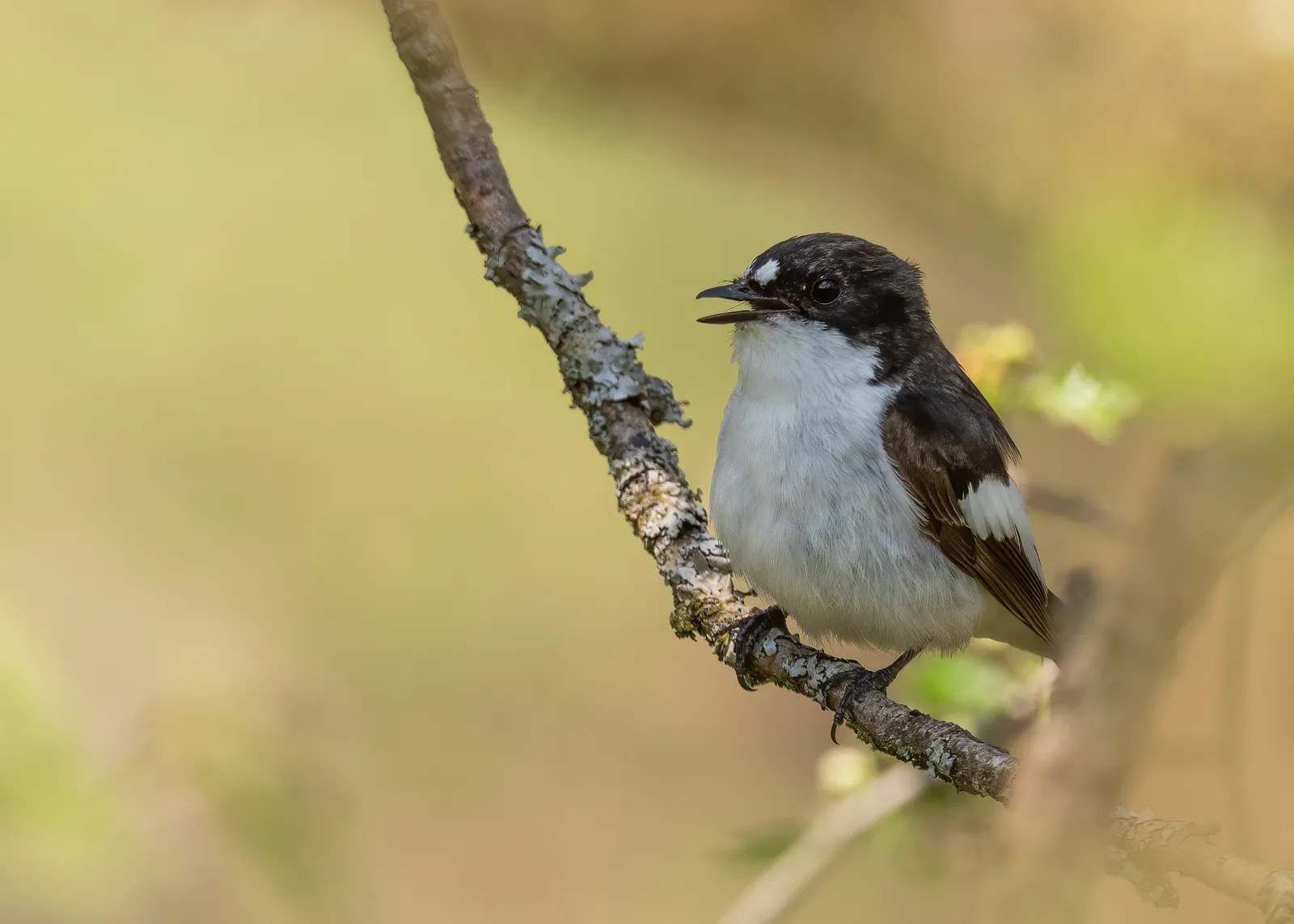
A 2006 study by Both and colleagues compared nine Dutch populations of the pied flycatcher, Ficedula hypoleuca. Declines were strongest where nestling food peaked early and breeding was mistimed relative to it. Where food peaked later, early-breeding birds remained better aligned and population declines were weaker.
This is a specific food-and-breeding mechanism. Recording an earlier arrival date by itself would miss whether chicks still met the food peak. The relevant comparison is the timing of the interacting organisms, alongside the reproductive result.
That study's historical populations are not a current estimate for all flycatchers or migratory birds. Its value here is the comparison among sites with different seasonal food patterns. For an introduction to seasonal observations, read The Wisdom of Seasons; this case adds a documented link to population change.
Australia: a short heat event can have uneven effects
Welbergen and colleagues' 2008 study examined flying-fox deaths during extreme heat in New South Wales, including an event on 12 January 2002. Researchers recorded heat-coping behaviours and found differences in mortality between black and grey-headed flying-foxes, and among age and sex groups.
The observation matters because an annual average temperature cannot describe every damaging exposure. A short extreme can affect survival even when the yearly average seems modest. In this study, being a tropical species did not guarantee greater tolerance of the observed conditions.
The paper documents biological effects of a heat event and discusses implications under a warming climate. It does not, by itself, calculate how much human-caused warming increased that event's probability. Distinguishing impact evidence from event attribution keeps the conclusion accurate.
Corals: stress can disrupt a living partnership
Corals are animals. Many reef-building corals live with algae in their tissues, and that association can break down under stress. NOAA's explanation of coral bleaching describes how unusually warm water can cause corals to expel those algae and lose colour.
A bleached coral is stressed, but it is not automatically dead. Survival and recovery depend on the severity and persistence of the stress. Temperature is also not the only possible cause of bleaching. A photograph should therefore be paired with water-condition records and repeat observations before it is used to claim a cause or a recovery.
This example broadens the question beyond movement. Some animals cannot simply relocate to cooler conditions, and an important response may occur within a relationship between organisms. A reef assessment needs observations of coral condition, not just a count of fish seen on one visit.
What would a useful observation record look like?
Imagine a school or conservation team following a familiar bird population over several seasons. The following is an illustrative recording framework, not a field protocol or a real dataset. Its purpose is to show the difference between an interesting observation and evidence for a particular mechanism.
| Record | Why keep it? |
|---|---|
| Species identification and life stage | Adults, young and different species may respond differently. |
| Location, dates, route and observation effort | Make repeated observations interpretable rather than comparing unequal visits. |
| Relevant conditions | Record the temperature, rainfall or habitat feature linked to the actual question. |
| Food and breeding observations | Test timing relationships instead of assuming that an earlier season is better or worse. |
| Habitat work and other disturbances | Keep alternative explanations visible when conditions change together. |
| Uncertain or missing observations | Separate an animal not detected from an animal shown to be absent. |
Choose a question narrow enough to answer. “Did the food peak and breeding dates become less aligned at these sites?” is more useful than “Did climate change harm all our wildlife?” Review the design before collecting records, especially where sensitive species or nests are involved. Observing wildlife should not require approaching or disturbing breeding animals.
Satellite observations can help describe land cover or environmental conditions, but they do not establish a bird's breeding success or a bat's survival. Those outcomes need suitable biological evidence. The biodiversity measurement guide explains how the question should determine the survey and indicator.
Questions about animals and a changing climate
Can animals simply move somewhere cooler?
Some populations shift their ranges. A cooler location still needs suitable habitat, food and access, and successful movement does not ensure successful reproduction. The Himalayan study shows why habitat condition belongs in that assessment.
Does an earlier spring help wildlife?
It depends on which seasonal events change and whether they remain aligned. An earlier food peak can help one population and leave another short of food during breeding. Measure the relationship rather than treating earlier timing as a benefit by itself.
Is climate change the only threat to animals?
No. Habitat conversion, exploitation, pollution and invasive species can act alongside it. The biodiversity-loss guide explains these other pressures and why local conservation needs to address the combination present.
Sources checked on 31 October 2026. The named studies are historical evidence of particular mechanisms, not current population estimates for every species or region.
Can animals reach suitable habitat?
Understand how fragmentation affects movement and what evidence a wildlife corridor needs.
Explore habitat fragmentation and corridors